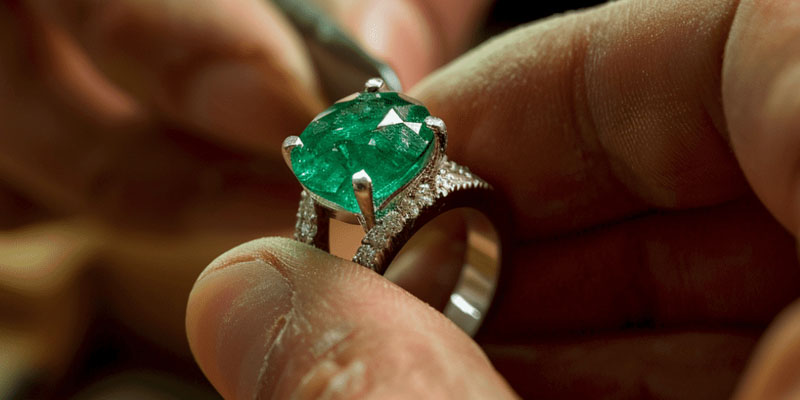
Would you select a loose round emerald gemstone because it has few inclusions, or would you first consider whether its colour, clarity, treatments, and durability are appropriate for your jewellery design?
This is important since the criteria used to assess an emerald differ from those of a diamond. Inclusions in emeralds are common in nature, and sometimes a less clean emerald might be more aesthetically appealing. The selection of a loose round emerald gemstone should take into account the combination of colour, clarity, cut, treatments, origins, size and purpose.
Colour is certainly something to think about early on.
An excellent emerald will have a vibrant and pleasing green colour, rich in saturation, and with the right tone. One which is too dark may be visually dull, while one which is too light may lack the vibrancy of a top-quality emerald.
The colour cannot be assessed using only the spotlights available in jewellery shops. The emerald should be checked using other light sources such as neutral and natural light. Can the emerald hold up under different lighting conditions?
The colour should complement the metal used in the jewellery. The yellow gold may warm up the look of the emerald , while white metals can give more contrast.
It is rare to have an emerald gemstone that does not have any inclusions within. These internal elements are called Jardin, a French word meaning garden.
It would be a mistake to dismiss a gem just because of its inclusions. It is more important to analyse what kind of inclusions are there and how they affect transparency.
It is crucial to know the difference between beautiful internal structures and inclusions that may affect the gem’s durability. A heavily fractured gem needs extra care.
In customised jewellery, it is important to consider whether inclusions may affect the appearance or safety of wearing the stone.
Round cut emeralds require great attention since the cutter should be able to combine color, weight, symmetry, and durability.
Check the symmetry of the emerald from above by looking at whether the shape is a perfect circle. Notice any uneven edges, clear asymmetry, excessive darkness or lightness.
The carat of the stone does not necessarily affect the appearance of the stone. Two gems with almost equal carats may have completely different appearances.
The proportionate stone with beautiful colour and transparency might be more suitable than a heavier one with poor visual appearance.
Clarity enhancement is common in natural emeralds. Fractures may be filled with materials such as oils or other clarity-enhancing substances to improve the stone's apparent clarity.
Treatment matters because it can affect value, care requirements, appearance, and how the gemstone should be handled during jewellery manufacture and cleaning.
Before purchasing, ask:
A reputable gemmological laboratory report can provide independent information about the gemstone and relevant treatment.
Colombia and Zambia are important sources of natural emeralds, but origin alone does not determine whether a particular stone is superior.
A Colombian emerald is not automatically better than a Zambian emerald. Colour, transparency, clarity characteristics, treatment, cut, and overall appearance still need to be assessed.
If an origin premium is significant, request laboratory documentation supporting the origin rather than relying solely on a seller's claim.
The correct gemstone selection will also depend on its use.
For rings, the toughness of the stone and its setting need to be considered since it is prone to impacts.
For pendants, the emerald is likely not going to get too many impacts and allows more options in terms of setting.
For earrings, symmetry and matching of the stones is an issue when choosing two emeralds.
Some rings that have emeralds as their stones may require a protective bezel or prong setting due to fractures in the stone. The jeweller must assess the actual stone before choosing the setting.
Carat weight is not enough for custom jewellery.
Record the emerald's exact length, width, and depth before the setting is manufactured. Stones with identical weights can have different dimensions because cutting proportions vary.
Providing these measurements to the jeweller allows the setting to be engineered around the actual gemstone rather than forcing the stone into a predetermined design.
While selecting a Loose Round Emerald Gemstone, consider all aspects of this item, including colour, clarity, inclusions, cut, treatment, provenance, size, and purpose.
A "perfect" emerald is not always the biggest, the purest, and the most expensive one. It is the gemstone which fits best for a particular jewellery design, price, appearance, treatment, and durability.
If you need to select a Loose Round Emerald Gemstone for custom-made jewellery, get in touch with our gemstone experts to find out about the availability of specific stones, laboratory reports, treatments, sizes, and settings.